How Hackers profit from your stolen medical data.
Data breaches have become so commonplace that people don't take notice of them as they should. Everyone is aware of illegal activities associated with stolen credit cards numbers that are used to make forgeries and illegal purchases, stolen ID and SSNs used in identity theft, but of greater value to cyber criminals are information stolen from health care facilities and institutions.
Stolen info based on health care records include not only personal/financial information but insurance documents, stolen doctor licenses, medical diplomas and more
"A hacker compromises the corporate network of a healthcare provider to find administrative paperwork that would support a forged doctor's identity. The hacker then sells to a buyer or intermediary (who then sells to the buyer) for a high enough price to ensure a return on investment but low enough to ensure multiple people buy the item.
The buyer poses as the stolen doctor's identity and submits claims to Medicare or other medical insurance providers for high-end surgeries."
The costs are high and only getting worse. HIPAA was enacted in 1996. Google, Inc. was founded in 1998. It could be time to revamp HIPAA and the way our medical information is protected.
Please read more at; https://www.zdnet.com/article/this-is-how-hackers-make-money-from-your-stolen-medical-data/?ftag=TRE49e8aa0&bhid=27630927001468733386426006914379
US to demand five years of your social media, email account info in visa application
The US State Department will now require new visitors to the United States to hand over their social media account names as well as email addresses and phone numbers used over the past five years.
The data demand will apply to tourists and potential immigrants.
https://www.zdnet.com/article/us-visa-agency-will-now-demand-your-social-media-email-account-info/?ftag=TRE49e8aa0&bhid=27630927001468733386426006914379
Intel Workstations - Solid State Drive based, Gen 8 & 9 Ultra Fast!
Tuesday, June 11, 2019
Tuesday, May 21, 2019
Microsoft kicks off the rollout of the Windows 10 May Update/1903
Microsoft's Windows 10 May Update/1903 is available to consumers and business customers as of today, May 21. It's available through WSUS, Windows Update for Business and VLSC starting today, too.
Starting today May 21, 2019, consumers and businesses can upgrade to the version 1903, the first feature update to Windows 10 in 2019. The update is available via download on WSUS, Windows Update for Business.
The latest version available prior to 1903 was version 1809. You can check which version you are on by using the Windows key + R, the type "Winver" and press the key. If you are not on version 1809, you can download and install version 1903 without doing the intermediary updates since Windows updates are cumulative.
Users can still delay by 35 days the update however Microsoft is not pushing it on users currently. Microsoft indicated in April that it was changing the way it rolls out updates to users after the troubles caused by the October 2018/1809 update that caused data loss for some users.
The new update has many new features including "SandBox" which allows Windows Pro, Enterprise and Education users to run potential risky software isolated helping to keep your system safe and secure.
https://www.zdnet.com/pictures/windows-10-update-the-new-features-that-matter-most/16/
I will be updating my system tonight and let you know how it goes.
For the entire story click on the link below;
https://www.zdnet.com/article/microsoft-kicks-off-the-rollout-of-the-windows-10-may-update-1903/?ftag=TREc64629f&bhid=2219791
Starting today May 21, 2019, consumers and businesses can upgrade to the version 1903, the first feature update to Windows 10 in 2019. The update is available via download on WSUS, Windows Update for Business.
The latest version available prior to 1903 was version 1809. You can check which version you are on by using the Windows key + R, the type "Winver" and press the
Users can still delay by 35 days the update however Microsoft is not pushing it on users currently. Microsoft indicated in April that it was changing the way it rolls out updates to users after the troubles caused by the October 2018/1809 update that caused data loss for some users.
The new update has many new features including "SandBox" which allows Windows Pro, Enterprise and Education users to run potential risky software isolated helping to keep your system safe and secure.
https://www.zdnet.com/pictures/windows-10-update-the-new-features-that-matter-most/16/
I will be updating my system tonight and let you know how it goes.
For the entire story click on the link below;
https://www.zdnet.com/article/microsoft-kicks-off-the-rollout-of-the-windows-10-may-update-1903/?ftag=TREc64629f&bhid=2219791
Wednesday, May 15, 2019
Warning! If You Save your Passwords in a Browser, Don't miss this Blog Post
If you use your favorite internet browsing program to save passwords for websites, you might want to rethink this policy. This includes all browser programs, Chrome, Firefox, IE and Safari. In 3 of these, I found the saved passwords were only protected by a user's password or in the case of Safari, the Admin password. The other major browser has a default policy of no password and will expose passwords with a few clicks of the mouse, however, it does allow you to set a Master password separate from a user password.
If you continue to use this method to save passwords please use a strong password and not one you use for all your protection including websites. However, if your browser uses a User or Admin password to protect saved website passwords, I have programs that can crack a forgotten password or generate a new password for a user. In the event your computer is stolen or accessed by a hacker or criminal, they can simply change your password and then proceed to steal your financial website's user name and password.
Lastly, beware this information is readily available using a Googe search.
Google Chrome
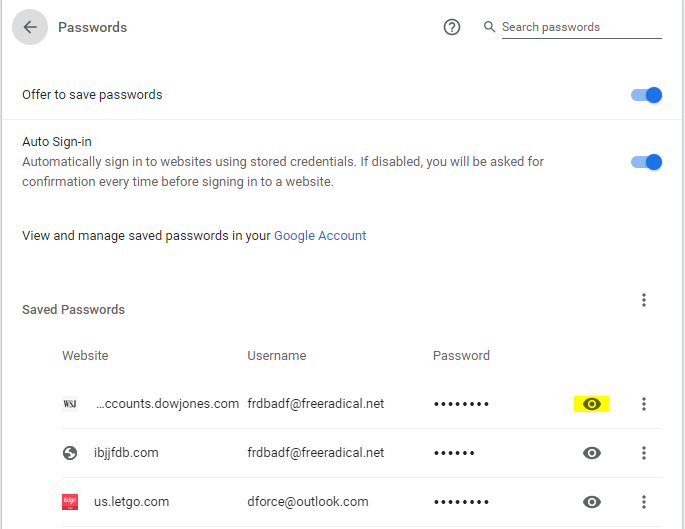
By default, passwords in Chrome's password list are masked by dots to prevent one from seeing the actual password, however by simply clicking on the eye icon next to a password Windows will prompt you for your user login password or pin and voila, all passwords can be viewed by clicking on the eye icon to the right of a saved password.
If you have ever shared your password with a family member, co-worker or haphazardly use easy passwords for protection then any financial, confidential or social media sites you visit that have a saved password can be viewed and compromised. And let me add this, if I know this then hackers and criminals know this and if your computer is compromised by a trojan or malware then they know where to look to get access to your confidential Financial and Personal information. These steps are easily found by Googling for the information.
To illustrate how to expose your password info under Chrome, click on the 3 dots in a line, upper right corner of Chrome browser, then select Settings from the drop-down.
Next click on Passwords,
When you do this the saved and not saved Password list appears
Once the list appears, all I have to do is click on the eye icon and the system will respond with the following Window asking for the computer password/pin.
Once you have provided the computer with the correct password/pin, Chrome will then allow you to reveal the hidden password for every saved account.
Below is my IBJJF password exposed (since changed)...
You might think all this is bad enough but no, there's more.
I have a Chromebook and Android phones. If you have provided your Gmail account to these devices and have Sync and personalize Chrome across your devices turned on, you can go to My Google and find all saved passwords from your Chrome and Android based devices.
Mozilla Firefox and Microsoft Internet Explorer
You may think I'm saying not to use Google Chrome or I am picking on Chrome. I started with Chrome because it is the most popular Windows Browser now. However, FireFox and IE both have the same issue.
The default setting for Firefox doesn't require you to provide a password/pin to show passwords. All you have to do in Firefox is click on the settings icon in the upper right of the Firefox browser, select options,
choose Privacy & Security,
next click on Login & Passwords, Saved Logins.
click on Saved Logins and you are 1 step away for revealing all saved passwords.
Note: Mozilla does allow you to "Use a master password" which you will want to do. This is a better option in my opinion than using the user password for a computer, however as stated this is not the default and Mozilla is wide open otherwise.
Internet Explorer
To accomplish the same feat in IE, go to Internet Tools. If your browser has the Menu Bar option on simply click on Tools and then select Internet Tools from the dropdown, if you don't see the Menu Bar you can access Internet Tools from the Control Panel.
Next click on the Content Tab and select Settings under AutoComplete
Click on Manage Passwords
To expose a password click on the carat symbol to the right of the password.
As you can see the user ID is already there, you will be asked to provide the user password/pin to reveal the password.
Safari
Apple's Safari browser protects Macs behind the Admin password. This is only as secure as the password is strong and breakable using 3rd party hacker software.
Tuesday, May 7, 2019
Ransomware, Malware attacks - Protection is important but a Recovery Plan is equally important, Israel responds to Hamas hackers with Air Strike
Ransomware: The key lesson Maersk learned from battling the NotPetya attack
In 2017 Maersk the shipping giant based in Denmark was hit by the NotPetya Ransomware. Maersk was not an intended target by the developers. NotPetya was developed by the Russian military and assisted by a leaked version of the NSA EternalBlue Hacking tool which helped to spread the WannaCry ransomware outbreak. NotPetya's intended target was businesses located in Ukraine, however, it was soon out of control and spreading and causing damage around the world costing billions of dollars in lost revenue and IT costs.
Ransomware and malware require constant vigilance and protection to prevent it from affecting your organization. With many nation states and their intelligence agencies focussed on cyberwarfare against one another, it is a daunting task. It was a worm developed by the NSA "Stuxnet" that brought down the Iranian centrifuges in their nuclear laboratories in 2010. Stuxnet like NotPetya was not contained and soon in the hands of criminal hackers wreaking havoc in businesses around the world.
But while protecting networks and critical systems is the ultimate goal, a data recovery plan must also be in place, so in the event of the worst happening and critical services being knocked out, you can still operate.
A significant part of this, said Woodcock, is "that ability to really understand the core business processes" and know everything about the systems and applications which run the operation.
I personally use redundant backup devices and software at my business clients. It is imperative that there is also backups kept offline in the event of the malware spreading to the backup devices.
To read more about what happened at Maersk;
https://www.zdnet.com/article/ransomware-the-key-lesson-maersk-learned-from-battling-the-notpetya-attack/
Windows Update: why it is important to update your systems and computers.
As new security holes are discovered and exploited, Microsoft releases updates patching these security risks. Computers that have not been patched or are using an old operating system are targeted by criminal hackers.
NSA's arsenal of Windows hacking tools has leaked
The NSA and other intelligence agencies are also targeting computers around the world. The NSA used Windows hacking tools to target several banks.
A new trove of alleged surveillance tools and exploits from the National Security Agency's elite hacking team have been released by the Shadow Brokers' hacking group.
The group Friday appeared to release tools designed to target Windows PCs and servers, along with presentations and files purporting to detail the agency's methods of carrying out clandestine surveillance.
https://www.zdnet.com/article/shadow-brokers-latest-file-drop-shows-nsa-targeted-windows-pcs-banks/
In a first, Israel responds to Hamas hackers with an air strike
Three years ago, NATO proclaimed "cyber" as a target in the modern era creating a new battlefield. Israel has now been the first to use military force to strike against a foe for using cyber warfare. Hamas had been engaging in attacks on Israel's cyberspace. In response, Israel launched an airstrike against as building in the Gaza strip housing Hamas cyber operatives.
"After dealing with the cyber dimension, the Air Force dealt with it in the physical dimension," said IDF spokesperson, Brig. Gen. Ronen Manlis. "At this point in time, Hamas has no cyber operational capabilities."
You don't want to miss this; read more at;
https://www.zdnet.com/article/in-a-first-israel-responds-to-hamas-hackers-with-an-air-strike/
If you are still running Windows XP and Windows 7, look to upgrade today to a new computer.
New DForce Intel 8th and 9th Generations Workstations.
In 2017 Maersk the shipping giant based in Denmark was hit by the NotPetya Ransomware. Maersk was not an intended target by the developers. NotPetya was developed by the Russian military and assisted by a leaked version of the NSA EternalBlue Hacking tool which helped to spread the WannaCry ransomware outbreak. NotPetya's intended target was businesses located in Ukraine, however, it was soon out of control and spreading and causing damage around the world costing billions of dollars in lost revenue and IT costs.
Ransomware and malware require constant vigilance and protection to prevent it from affecting your organization. With many nation states and their intelligence agencies focussed on cyberwarfare against one another, it is a daunting task. It was a worm developed by the NSA "Stuxnet" that brought down the Iranian centrifuges in their nuclear laboratories in 2010. Stuxnet like NotPetya was not contained and soon in the hands of criminal hackers wreaking havoc in businesses around the world.
But while protecting networks and critical systems is the ultimate goal, a data recovery plan must also be in place, so in the event of the worst happening and critical services being knocked out, you can still operate.
A significant part of this, said Woodcock, is "that ability to really understand the core business processes" and know everything about the systems and applications which run the operation.
I personally use redundant backup devices and software at my business clients. It is imperative that there is also backups kept offline in the event of the malware spreading to the backup devices.
To read more about what happened at Maersk;
https://www.zdnet.com/article/ransomware-the-key-lesson-maersk-learned-from-battling-the-notpetya-attack/
Windows Update: why it is important to update your systems and computers.
As new security holes are discovered and exploited, Microsoft releases updates patching these security risks. Computers that have not been patched or are using an old operating system are targeted by criminal hackers.
NSA's arsenal of Windows hacking tools has leaked
The NSA and other intelligence agencies are also targeting computers around the world. The NSA used Windows hacking tools to target several banks.
A new trove of alleged surveillance tools and exploits from the National Security Agency's elite hacking team have been released by the Shadow Brokers' hacking group.
The group Friday appeared to release tools designed to target Windows PCs and servers, along with presentations and files purporting to detail the agency's methods of carrying out clandestine surveillance.
https://www.zdnet.com/article/shadow-brokers-latest-file-drop-shows-nsa-targeted-windows-pcs-banks/
In a first, Israel responds to Hamas hackers with an air strike
Three years ago, NATO proclaimed "cyber" as a target in the modern era creating a new battlefield. Israel has now been the first to use military force to strike against a foe for using cyber warfare. Hamas had been engaging in attacks on Israel's cyberspace. In response, Israel launched an airstrike against as building in the Gaza strip housing Hamas cyber operatives.
"After dealing with the cyber dimension, the Air Force dealt with it in the physical dimension," said IDF spokesperson, Brig. Gen. Ronen Manlis. "At this point in time, Hamas has no cyber operational capabilities."
You don't want to miss this; read more at;
https://www.zdnet.com/article/in-a-first-israel-responds-to-hamas-hackers-with-an-air-strike/
If you are still running Windows XP and Windows 7, look to upgrade today to a new computer.
New DForce Intel 8th and 9th Generations Workstations.
Monday, April 29, 2019
Implantable Medical Devices - keeping them safe from Hackers, also Facebook will be taken over by the Dead in 50 years!
The future of cybersecurity: Your body as a hacker-proof network
Could a 'body area network' be the key to keeping medical devices safe or transferring data between individuals?
Modern medicine is making use of the internet with more devices having internet connectivity. Insulin pumps, pacemakers, and more implantable devices are being fitted with wireless internet connectivity that allows doctors to monitor your health remotely.
The issue with being connected to the internet is that the devices can be hacked. Already proof of concept attacks has illustrated the risk exists. Fortunately, there have been no attacks so far but cybercriminals have demonstrated a lack of morality and tampering with these devices will no doubt happen. In the past, they have extorted hospitals putting patients at risk.
The wireless technology used to share data can be read many feet away. Recently implantable defibrillators were given a severity rating of 9.3 out of 10 for a flaw that allowed them to be hacked 20 feet away by the Department of Homeland security.
Scary stuff but new research using the human body as the signal carrier restricts the signal to a few centimeters outside the patient. Researchers at Purdue University have created Electro-Quasistatic Human Body Communication (EQS-HBC) which uses low-frequency, carrier-less broadband transmission.
To read the full article click on the link below.
https://www.zdnet.com/article/the-future-of-cyber-security-your-body-as-a-hacker-proof-network/?ftag=TRE49e8aa0&bhid=27630927001468733386426006914379
The dead will take over Facebook in the next 50 years
Analysis suggests that the deceased will soon outnumber the living on the network.
and I thought it was me the reason no one responded to my posts. :-)
A time is coming in which you may see more memorial accounts on Facebook than active users, with academics estimating that accounts belonging to the deceased will outnumber the living within 50 years.
https://www.zdnet.com/article/the-dead-will-take-over-facebook-in-the-next-50-years/?ftag=TRE-03-10aaa6b&bhid=2219791
Could a 'body area network' be the key to keeping medical devices safe or transferring data between individuals?
Modern medicine is making use of the internet with more devices having internet connectivity. Insulin pumps, pacemakers, and more implantable devices are being fitted with wireless internet connectivity that allows doctors to monitor your health remotely.
The issue with being connected to the internet is that the devices can be hacked. Already proof of concept attacks has illustrated the risk exists. Fortunately, there have been no attacks so far but cybercriminals have demonstrated a lack of morality and tampering with these devices will no doubt happen. In the past, they have extorted hospitals putting patients at risk.
The wireless technology used to share data can be read many feet away. Recently implantable defibrillators were given a severity rating of 9.3 out of 10 for a flaw that allowed them to be hacked 20 feet away by the Department of Homeland security.
Scary stuff but new research using the human body as the signal carrier restricts the signal to a few centimeters outside the patient. Researchers at Purdue University have created Electro-Quasistatic Human Body Communication (EQS-HBC) which uses low-frequency, carrier-less broadband transmission.
To read the full article click on the link below.
https://www.zdnet.com/article/the-future-of-cyber-security-your-body-as-a-hacker-proof-network/?ftag=TRE49e8aa0&bhid=27630927001468733386426006914379
The dead will take over Facebook in the next 50 years
Analysis suggests that the deceased will soon outnumber the living on the network.
and I thought it was me the reason no one responded to my posts. :-)
A time is coming in which you may see more memorial accounts on Facebook than active users, with academics estimating that accounts belonging to the deceased will outnumber the living within 50 years.
https://www.zdnet.com/article/the-dead-will-take-over-facebook-in-the-next-50-years/?ftag=TRE-03-10aaa6b&bhid=2219791
Tuesday, April 16, 2019
Ransomware: The cost of rescuing your files is going up as attackers get more sophisticated
The average ransom demand is up to almost $13,000, compared with $6,700 just a few months ago.
The sharp increase in ransom payments is linked to the emergence of more expensive and more hands-on forms of ransomware like Ryuk, Bitpaymer and Dharma.
While ransomware attacks of the past generally relied on spamming out large numbers of phishing emails in the hope of getting a few hits, now cyber criminal groups are taking a more focused approach with attacks.
They are now attacking computers directly across the internet. The new forms of ransomware rely on more direct attacks on computers. They are exploiting security holes in remote desktop protocols (RDPs) to gain access to systems and once in they are attempting to infect and encrypt as many computers as possible on a network. That is why it is so important to install updates on your system and not to use outdated operating systems that are no longer supported by manufacturers, see prior post below.
https://dforceatl.blogspot.com/2019/04/windows-updates-problems-and-new.html
Office 365 users are targets of phishing attempts attempting to steal their credentials. It is easy to copy the underlying source code of a website, Office 365 portal for example and then publish it to create a fake website that looks like the genuine site (you must pay attention to URL). The target will receive an email allegedly from Microsoft threatening to close the account unless action is taken. The link to the phony site will then ask for your email and password. If the info is supplied, the attacker will then take charge of your account, encrypting OneDrive, Sharepoint and using the compromised email to send phony financial documents and other attachments which will appear to come from a trusted source by the recipients. Be careful.
If you are a victim of ransomware, the attackers can command ransom payments of six figure sums – which attackers demand in cryptocurrencies like Bitcoin.
While the authorities generally don't recommend that victims of ransomware attacks pay the ransom demand – it funds criminal activity and there is no guarantee it will work anyway – in some cases, organizations feel as if they don't have a choice.
It was last month that I wrote about Jackson County, Georgia paying $400,000 to criminals that had infected it's systems with ransomware.
https://dforceatl.blogspot.com/2019/03/georgia-county-pays-400000-to-hackers.html
To read more about the threats, use the links below.
https://www.zdnet.com/article/ransomware-the-cost-of-rescuing-your-files-is-going-up-as-attackers-get-more-sophisticated/
https://www.zdnet.com/article/ransomware-an-executive-guide-to-one-of-the-biggest-menaces-on-the-web/
The sharp increase in ransom payments is linked to the emergence of more expensive and more hands-on forms of ransomware like Ryuk, Bitpaymer and Dharma.
While ransomware attacks of the past generally relied on spamming out large numbers of phishing emails in the hope of getting a few hits, now cyber criminal groups are taking a more focused approach with attacks.
They are now attacking computers directly across the internet. The new forms of ransomware rely on more direct attacks on computers. They are exploiting security holes in remote desktop protocols (RDPs) to gain access to systems and once in they are attempting to infect and encrypt as many computers as possible on a network. That is why it is so important to install updates on your system and not to use outdated operating systems that are no longer supported by manufacturers, see prior post below.
https://dforceatl.blogspot.com/2019/04/windows-updates-problems-and-new.html
Office 365 users are targets of phishing attempts attempting to steal their credentials. It is easy to copy the underlying source code of a website, Office 365 portal for example and then publish it to create a fake website that looks like the genuine site (you must pay attention to URL). The target will receive an email allegedly from Microsoft threatening to close the account unless action is taken. The link to the phony site will then ask for your email and password. If the info is supplied, the attacker will then take charge of your account, encrypting OneDrive, Sharepoint and using the compromised email to send phony financial documents and other attachments which will appear to come from a trusted source by the recipients. Be careful.
If you are a victim of ransomware, the attackers can command ransom payments of six figure sums – which attackers demand in cryptocurrencies like Bitcoin.
While the authorities generally don't recommend that victims of ransomware attacks pay the ransom demand – it funds criminal activity and there is no guarantee it will work anyway – in some cases, organizations feel as if they don't have a choice.
It was last month that I wrote about Jackson County, Georgia paying $400,000 to criminals that had infected it's systems with ransomware.
https://dforceatl.blogspot.com/2019/03/georgia-county-pays-400000-to-hackers.html
To read more about the threats, use the links below.
https://www.zdnet.com/article/ransomware-the-cost-of-rescuing-your-files-is-going-up-as-attackers-get-more-sophisticated/
https://www.zdnet.com/article/ransomware-an-executive-guide-to-one-of-the-biggest-menaces-on-the-web/
Friday, April 12, 2019
Windows Updates - problems and new Feature Release 1903 due soon.
Since Windows as a Service (SaaS) became the norm with the introduction of Windows 10, Microsoft has been making changes to the way it rolls out updates to end-users to keep the OS up to date.
The update process has not been a smooth one. Microsoft's VP of Windows last week acknowledged that updating can be "disruptive". It was in October of 2018 when Microsoft rolled out version 1809 and many users found that their files had been deleted due to a bug. I'm not sure if the bug was part of the update or the new OS itself but Microsoft halted the update for 6 weeks until the issue had been resolved.
It's not an easy task for Microsoft. There are over 800 million PCs running Windows 10 worldwide. Unlike Apple which controls every facet of their products, there are hundreds if not thousands of PC hardware manufacturers. Since some make only components to be used in a finished PC, this leads to innumerable variations in hardware. Add to that all the available software that can be installed and user personalization that makes anticipating every outcome difficult if not impossible.
It is important that you update your Windows to ensure that security holes and bugs have been patched. Not doing so leaves your computer exposed to hackers and criminals who are always evolving as well as the tools they use to attack your system and steal your data.
There is a new feature coming with the next Windows feature release called "SandBox" that will allow your computer to run in a secure lightweight environment to protect your computer from Malware without affecting the normal Windows installation. Believe me, you will want this.
There are major updates available now for Windows version 1809 and we are on the cusp of the first major Windows feature release of 2019, version 1903 due for release any day now.
https://medium.com/@win10tricks/windows-10-1903-april-2019-update-release-date-new-features-and-improvements-f49953f6f595
If you are unsure which version you are on, execute the command "Winver" in the Search Box
or use run (Win +R), then type Winver. Your version will appear similar to below;
to read more, check the links below and Thanks for reading!
https://www.zdnet.com/article/windows-10-updates-why-microsofts-battle-isnt-over-yet/
Microsoft's April Patch Tuesday comes with fixes for two Windows zero-days
https://www.zdnet.com/article/microsofts-april-patch-tuesday-comes-with-fixes-for-two-windows-zero-days/?ftag=TRE-03-10aaa6b&bhid=2219791
Windows 7 problems: Microsoft blocks April updates to systems at risk of freezing
Microsoft has blocked this week's monthly and security-only Windows 7 and Windows 8.1 updates for Sophos antivirus users after widespread reports that computers failed to boot after installing them.
The problems are caused by Microsoft's Tuesday Windows 7 and Windows 8.1 monthly rollup and security-only updates KB4493467, KB4493446, KB4493448, KB4493472, KB4493450 and KB4493451.
https://www.zdnet.com/article/windows-7-problems-microsoft-blocks-april-updates-to-systems-at-risk-of-freezing/?ftag=TRE-03-10aaa6b&bhid=27630927001468733386426006914379
https://www.forbes.com/sites/daveywinder/2019/04/12/microsoft-confirms-latest-updates-are-freezing-windows-heres-how-to-fix-it/#4e025fb84d99
The update process has not been a smooth one. Microsoft's VP of Windows last week acknowledged that updating can be "disruptive". It was in October of 2018 when Microsoft rolled out version 1809 and many users found that their files had been deleted due to a bug. I'm not sure if the bug was part of the update or the new OS itself but Microsoft halted the update for 6 weeks until the issue had been resolved.
It's not an easy task for Microsoft. There are over 800 million PCs running Windows 10 worldwide. Unlike Apple which controls every facet of their products, there are hundreds if not thousands of PC hardware manufacturers. Since some make only components to be used in a finished PC, this leads to innumerable variations in hardware. Add to that all the available software that can be installed and user personalization that makes anticipating every outcome difficult if not impossible.
It is important that you update your Windows to ensure that security holes and bugs have been patched. Not doing so leaves your computer exposed to hackers and criminals who are always evolving as well as the tools they use to attack your system and steal your data.
There is a new feature coming with the next Windows feature release called "SandBox" that will allow your computer to run in a secure lightweight environment to protect your computer from Malware without affecting the normal Windows installation. Believe me, you will want this.
There are major updates available now for Windows version 1809 and we are on the cusp of the first major Windows feature release of 2019, version 1903 due for release any day now.
https://medium.com/@win10tricks/windows-10-1903-april-2019-update-release-date-new-features-and-improvements-f49953f6f595
If you are unsure which version you are on, execute the command "Winver" in the Search Box
or use run (Win +R), then type Winver. Your version will appear similar to below;
to read more, check the links below and Thanks for reading!
https://www.zdnet.com/article/windows-10-updates-why-microsofts-battle-isnt-over-yet/
Microsoft's April Patch Tuesday comes with fixes for two Windows zero-days
https://www.zdnet.com/article/microsofts-april-patch-tuesday-comes-with-fixes-for-two-windows-zero-days/?ftag=TRE-03-10aaa6b&bhid=2219791
Windows 7 problems: Microsoft blocks April updates to systems at risk of freezing
Microsoft has blocked this week's monthly and security-only Windows 7 and Windows 8.1 updates for Sophos antivirus users after widespread reports that computers failed to boot after installing them.
The problems are caused by Microsoft's Tuesday Windows 7 and Windows 8.1 monthly rollup and security-only updates KB4493467, KB4493446, KB4493448, KB4493472, KB4493450 and KB4493451.
https://www.zdnet.com/article/windows-7-problems-microsoft-blocks-april-updates-to-systems-at-risk-of-freezing/?ftag=TRE-03-10aaa6b&bhid=27630927001468733386426006914379
https://www.forbes.com/sites/daveywinder/2019/04/12/microsoft-confirms-latest-updates-are-freezing-windows-heres-how-to-fix-it/#4e025fb84d99
New Intel 8th and 9th Generations Workstations.
Wednesday, April 3, 2019
GA Tech 1.3 million data breach, Albany NY, latest victim of Ransomware. Is your Office 365 OneDrive and SharePoint safe?
Potentially 1.3 million current and former students affected by Georgia Tech data breach
Although world renowned for its computer science programs, Georgia Tech has exposed the second data breach to occur at the school in less than a year. The news was announced yesterday and the potential fallout of exposed names, addresses, SSNs, and birth dates could affect 1.3 million current and former students.
Read all the details in the following link;
https://www.ajc.com/news/breaking-news/breaking-data-breach-exposes-georgia-tech-faculty-students/zAUUNWy5hoHQ8bNvMxcsWL/
New York capital hit by ransomware attack, taking services offline
Albany, NY is just the latest city to become a victim of ransomware, the city announced Saturday, 03/30/19. City services impacted so far is limited to its ability to offer birth, death and marriage certificates. People seeking these services are having to visit state vital records offices.
Albany police are said to have no access to any service or program that relies on internet connection.
The situation is still being assessed and inquiries to the Mayor's office on Monday were not being responded to.
Ransomware attacks on cities have been increasing due to lax security and that the attack is more likely to be successful. Citizens depend on city government services thus city official feel more pressure to resolve the situation.
Gregory McGee, the Police union's vice president, said that the ransomware was also affecting computers in patrol cars related to "incident and accident reports." "One has to ask the question of why a police department with sensitive information is on the same network that was so easily attacked."
In March of 2018, Atlanta, GA was targeted. City officials refused to pay and recently the ongoing recovery process has been estimated to cost $17 million.
Two Iranian hackers have been charged by the Justice Department with using malware to attack targets with critical infrastructure or that offer critical services. Hospitals have been targetted and in many cases, the victims could not pay but the alleged hackers have still taken in $6 million. The Iranians remain at large since there is no extradition treaty with Iran.
https://www.bleepingcomputer.com/news/security/new-york-albany-capital-hit-by-ransomware-attack/
https://www.cnet.com/news/new-york-capital-hit-by-ransomware-attack-taking-services-offline/
Office 365, OneDrive and SharePoint folders. Are you safe from Ransomware?
Many companies today have Office 365 and use OneDrive and Sharepoint to synchronize their onsite server and Cloud services. This is a backup in the traditional sense. However, ransomware encrypts the files on your system, rendering them unusable. They cannot be opened or viewed without the key to decrypt them. Hence the term ransomware because the attacker generally will request a payment be made in cryptocurrency to obtain the key.
If your server or computer is attacked by ransomware and it syncs with your cloud then it will overwrite the files in the cloud. Fortunately, OneDrive has a feature called versioning. Up to 50 previous versions of any Microsoft Office file exists and you can revert to the good version that was overwritten.
Unfortunately, this works only for MS Office files. Ransomware will encrypt jpegs, PDFs and all files located on a computer. So all non-related Microsoft Office files are subject to be lost. It will also be time-consuming and troublesome to have to reversion all your Office data.
It is therefore imperative that you keep multiple day backups of your data. You should keep multiple days in case the attack happens and goes undetected for a day or two. If you have only a single day backup, say the same backup occurs to the same external drive daily and you get attacked, you could end up with a backup of the encrypted data.
Redundant backups are a good insurance policy in the event of a Malware attack. Hardware failure is no longer the main threat to your data. Organizations and staff must protect against the constant threat of malware and ransomware in today's IT climate. A good backup plan is essential to safeguard your data.
Start examining your backup and security needs today before it's too late.
Support for Windows 7 ending 01/14/2020.
If you are still using XP based systems then there has not been any security patches or updates to your computer since 04/08/2014. Experts agree that you should not use Windows XP based computers to access information and email on the internet. There aren't any modern browsers or AV software for these computers available any longer and the risks to your data and personal info is exponential.
In approximately 8 months support for Windows 7 ends.
Plan today to upgrade your systems to a new DForce Intel based computer with the newest Generation 8 and 9 Intel processors running Windows 10.
Although world renowned for its computer science programs, Georgia Tech has exposed the second data breach to occur at the school in less than a year. The news was announced yesterday and the potential fallout of exposed names, addresses, SSNs, and birth dates could affect 1.3 million current and former students.
Read all the details in the following link;
https://www.ajc.com/news/breaking-news/breaking-data-breach-exposes-georgia-tech-faculty-students/zAUUNWy5hoHQ8bNvMxcsWL/
New York capital hit by ransomware attack, taking services offline
Albany, NY is just the latest city to become a victim of ransomware, the city announced Saturday, 03/30/19. City services impacted so far is limited to its ability to offer birth, death and marriage certificates. People seeking these services are having to visit state vital records offices.
Albany police are said to have no access to any service or program that relies on internet connection.
The situation is still being assessed and inquiries to the Mayor's office on Monday were not being responded to.
Ransomware attacks on cities have been increasing due to lax security and that the attack is more likely to be successful. Citizens depend on city government services thus city official feel more pressure to resolve the situation.
Gregory McGee, the Police union's vice president, said that the ransomware was also affecting computers in patrol cars related to "incident and accident reports." "One has to ask the question of why a police department with sensitive information is on the same network that was so easily attacked."
In March of 2018, Atlanta, GA was targeted. City officials refused to pay and recently the ongoing recovery process has been estimated to cost $17 million.
Two Iranian hackers have been charged by the Justice Department with using malware to attack targets with critical infrastructure or that offer critical services. Hospitals have been targetted and in many cases, the victims could not pay but the alleged hackers have still taken in $6 million. The Iranians remain at large since there is no extradition treaty with Iran.
https://www.bleepingcomputer.com/news/security/new-york-albany-capital-hit-by-ransomware-attack/
https://www.cnet.com/news/new-york-capital-hit-by-ransomware-attack-taking-services-offline/
Office 365, OneDrive and SharePoint folders. Are you safe from Ransomware?
Many companies today have Office 365 and use OneDrive and Sharepoint to synchronize their onsite server and Cloud services. This is a backup in the traditional sense. However, ransomware encrypts the files on your system, rendering them unusable. They cannot be opened or viewed without the key to decrypt them. Hence the term ransomware because the attacker generally will request a payment be made in cryptocurrency to obtain the key.
If your server or computer is attacked by ransomware and it syncs with your cloud then it will overwrite the files in the cloud. Fortunately, OneDrive has a feature called versioning. Up to 50 previous versions of any Microsoft Office file exists and you can revert to the good version that was overwritten.
Unfortunately, this works only for MS Office files. Ransomware will encrypt jpegs, PDFs and all files located on a computer. So all non-related Microsoft Office files are subject to be lost. It will also be time-consuming and troublesome to have to reversion all your Office data.
It is therefore imperative that you keep multiple day backups of your data. You should keep multiple days in case the attack happens and goes undetected for a day or two. If you have only a single day backup, say the same backup occurs to the same external drive daily and you get attacked, you could end up with a backup of the encrypted data.
Redundant backups are a good insurance policy in the event of a Malware attack. Hardware failure is no longer the main threat to your data. Organizations and staff must protect against the constant threat of malware and ransomware in today's IT climate. A good backup plan is essential to safeguard your data.
Start examining your backup and security needs today before it's too late.
Support for Windows 7 ending 01/14/2020.
If you are still using XP based systems then there has not been any security patches or updates to your computer since 04/08/2014. Experts agree that you should not use Windows XP based computers to access information and email on the internet. There aren't any modern browsers or AV software for these computers available any longer and the risks to your data and personal info is exponential.
In approximately 8 months support for Windows 7 ends.
Plan today to upgrade your systems to a new DForce Intel based computer with the newest Generation 8 and 9 Intel processors running Windows 10.
Tuesday, April 2, 2019
Software glitches, Fatal results. Boeing 737 Max and now Tesla Autopilot hacked.
Everyone I'm sure has heard about the awful fate of the 2 Boeing 737 Max crashes.
The crashes were linked to a faulty device called the angle-of-attack sensor which incorrectly activated an automated system that caused a nosedive that the pilots could not recover from. As of yesterday 4/1/19 the fleet remains grounded.
Boeing’s software update for its troubled 737 Max jetliners has been delayed after the company deemed further work was needed on the fix before it was submitted to the Federal Aviation Administration.
The Max, Boeing’s newest plane, was grounded by regulators around the world in March after the crashes of two Max aircraft within five months.
As part of its process to return the Max to the air, Boeing has been working on a software update to new anti-stall system, known as MCAS, that was included in the Max.
https://www.nytimes.com/2019/04/01/business/boeing-737-max-software-fix.html
and now this;
Hackers reveal how to trick a Tesla into steering towards oncoming traffic
It's bad enough when your computer crashes due to a faulty update or glitch in the software. Hell, I was mad when Sony updated my Android TV and it crashed daily until I got another update. However, I don't want to think about such errors threatening my well being and health or that of others.
The latest thing to worry about is autopilot on your car. Hackers have now revealed that they were able to trick Tesla's autopilot feature to steer into the wrong lane remotely.
The team of hackers was able to insert malicious code into the steering wheel controls and connect it to a Bluetooth gamepad controller.
The Autosteer mode of the vehicle use camera feeds and computer vision to navigate traffic lanes. The researchers were able to tamper with how the vehicle recognizes traffic lanes.
Tencent researchers tested out their theory by applying some simple stickers to a road surface, and this confused the machine vision system enough to go AWOL and, theoretically, could be used to divert these cars into oncoming traffic.
Tesla reports that this is not a real concern of theirs since the driver can simply override Autopilot at any time by using the steering wheel or brakes. However, Boeing said the same thing about the override for the pitch control on the 737 Max only some pilots had not been trained on this. I hate to think about the average Tesla driver's abilities, not paying attention or panic overriding correct actions.
Technology is a wonderful thing but when it comes to certain things, people should not become overly reliant upon technology. Tencent researchers, the hacker group who brought this to light, did so in the name of safety. I'd hate to think what a teenager would do with the knowledge and capability to execute this.
When it comes to Tesla, the company is not exempt from the same security concerns -- having recently been hacked at Pwn2Own -- but the vehicle range's computer systems can also come in useful, too, beyond Autopilot. Earlier this week, the Tesla's Model 3 new Sentry Mode caught a vandal in the act while she was scratching up the car, leading to her arrest.
Read the entire article at;
https://www.zdnet.com/article/hackers-reveal-how-to-trick-a-tesla-into-steering-towards-oncoming-traffic/?ftag=TRE-03-10aaa6b&bhid=27630927001468733386426006914379
The crashes were linked to a faulty device called the angle-of-attack sensor which incorrectly activated an automated system that caused a nosedive that the pilots could not recover from. As of yesterday 4/1/19 the fleet remains grounded.
Boeing’s software update for its troubled 737 Max jetliners has been delayed after the company deemed further work was needed on the fix before it was submitted to the Federal Aviation Administration.
The Max, Boeing’s newest plane, was grounded by regulators around the world in March after the crashes of two Max aircraft within five months.
As part of its process to return the Max to the air, Boeing has been working on a software update to new anti-stall system, known as MCAS, that was included in the Max.
https://www.nytimes.com/2019/04/01/business/boeing-737-max-software-fix.html
and now this;
Hackers reveal how to trick a Tesla into steering towards oncoming traffic
It's bad enough when your computer crashes due to a faulty update or glitch in the software. Hell, I was mad when Sony updated my Android TV and it crashed daily until I got another update. However, I don't want to think about such errors threatening my well being and health or that of others.
The latest thing to worry about is autopilot on your car. Hackers have now revealed that they were able to trick Tesla's autopilot feature to steer into the wrong lane remotely.
The team of hackers was able to insert malicious code into the steering wheel controls and connect it to a Bluetooth gamepad controller.
The Autosteer mode of the vehicle use camera feeds and computer vision to navigate traffic lanes. The researchers were able to tamper with how the vehicle recognizes traffic lanes.
Tencent researchers tested out their theory by applying some simple stickers to a road surface, and this confused the machine vision system enough to go AWOL and, theoretically, could be used to divert these cars into oncoming traffic.
Tesla reports that this is not a real concern of theirs since the driver can simply override Autopilot at any time by using the steering wheel or brakes. However, Boeing said the same thing about the override for the pitch control on the 737 Max only some pilots had not been trained on this. I hate to think about the average Tesla driver's abilities, not paying attention or panic overriding correct actions.
Technology is a wonderful thing but when it comes to certain things, people should not become overly reliant upon technology. Tencent researchers, the hacker group who brought this to light, did so in the name of safety. I'd hate to think what a teenager would do with the knowledge and capability to execute this.
When it comes to Tesla, the company is not exempt from the same security concerns -- having recently been hacked at Pwn2Own -- but the vehicle range's computer systems can also come in useful, too, beyond Autopilot. Earlier this week, the Tesla's Model 3 new Sentry Mode caught a vandal in the act while she was scratching up the car, leading to her arrest.
Read the entire article at;
https://www.zdnet.com/article/hackers-reveal-how-to-trick-a-tesla-into-steering-towards-oncoming-traffic/?ftag=TRE-03-10aaa6b&bhid=27630927001468733386426006914379
Thursday, March 21, 2019
Testing your Internet. Are you getting what you pay for and is it enough?
Internet connectivity, now and in the near future.
We are constantly being pitched sales ads about entertainment and internet connectivity options. Dish versus cable, WiFi, Fiber, and streaming. Your bandwidth is a constant and with the increasing demands being placed on it by more and more connected devices you may be seeing some performance degradation in your online experience.
Although the theoretical peak bandwidth of a network connection is fixed according to the technology used, the actual amount of data that flows over it (called "throughput") varies over time and is affected by higher and lower latencies.
If you only Facebook, email or surf the internet, you can probably get by with a low-end plan from your internet service provider (ISP). However, if you have multiple TVs streaming Netflix, Prime, Hulu, and other entertainment services and more than 1 computer, you need all the bandwidth you can get. Don't forget the smartphones, Alexa(s), Google Home, and Ring doorbells live streaming video to your phones, Alexa devices, and computers.
Bandwidth is analogous to the plumbing in your house. Just like larger plumbing pipes have the ability to increase the flow of water in your house, increased bandwidth allows for a larger flow of data to and from your connected devices. Too little bandwidth can cause slow performance, choppiness even stoppage on your TVs, computers, and devices.
How to test your Internet Speed. The following link is to a site that will accurately measure your internet speed and give you an idea of your present bandwidth. It also measures latency.
https://speedof.me/
Excessive latency creates bottlenecks that prevent data from filling the network pipe, thus decreasing throughput and limiting the maximum effective bandwidth of a connection. The impact of latency on network throughput can be temporary (lasting a few seconds) or persistent (constant), depending on the source of the delays.
https://www.lifewire.com/latency-on-computer-networks-818119
We are constantly being pitched sales ads about entertainment and internet connectivity options. Dish versus cable, WiFi, Fiber, and streaming. Your bandwidth is a constant and with the increasing demands being placed on it by more and more connected devices you may be seeing some performance degradation in your online experience.
Although the theoretical peak bandwidth of a network connection is fixed according to the technology used, the actual amount of data that flows over it (called "throughput") varies over time and is affected by higher and lower latencies.
If you only Facebook, email or surf the internet, you can probably get by with a low-end plan from your internet service provider (ISP). However, if you have multiple TVs streaming Netflix, Prime, Hulu, and other entertainment services and more than 1 computer, you need all the bandwidth you can get. Don't forget the smartphones, Alexa(s), Google Home, and Ring doorbells live streaming video to your phones, Alexa devices, and computers.
Bandwidth is analogous to the plumbing in your house. Just like larger plumbing pipes have the ability to increase the flow of water in your house, increased bandwidth allows for a larger flow of data to and from your connected devices. Too little bandwidth can cause slow performance, choppiness even stoppage on your TVs, computers, and devices.
How to test your Internet Speed. The following link is to a site that will accurately measure your internet speed and give you an idea of your present bandwidth. It also measures latency.
https://speedof.me/
Excessive latency creates bottlenecks that prevent data from filling the network pipe, thus decreasing throughput and limiting the maximum effective bandwidth of a connection. The impact of latency on network throughput can be temporary (lasting a few seconds) or persistent (constant), depending on the source of the delays.
https://www.lifewire.com/latency-on-computer-networks-818119
Subscribe to:
Posts (Atom)
-
The term Pig Butchering refers to the victims of scammers. The scammers nurture relationships with their targets before luring them in for t...
-
Acer C7 Chromebook from Google Play, $199 What can you get for $199? Dual-core Intel Celeron Processor 2 GB DDR3 RAM 320 GB hard d...
-
Dark Mode in Windows 10 If you are like millions of computer users the constant glare of bright white backgrounds on your computer screen ...